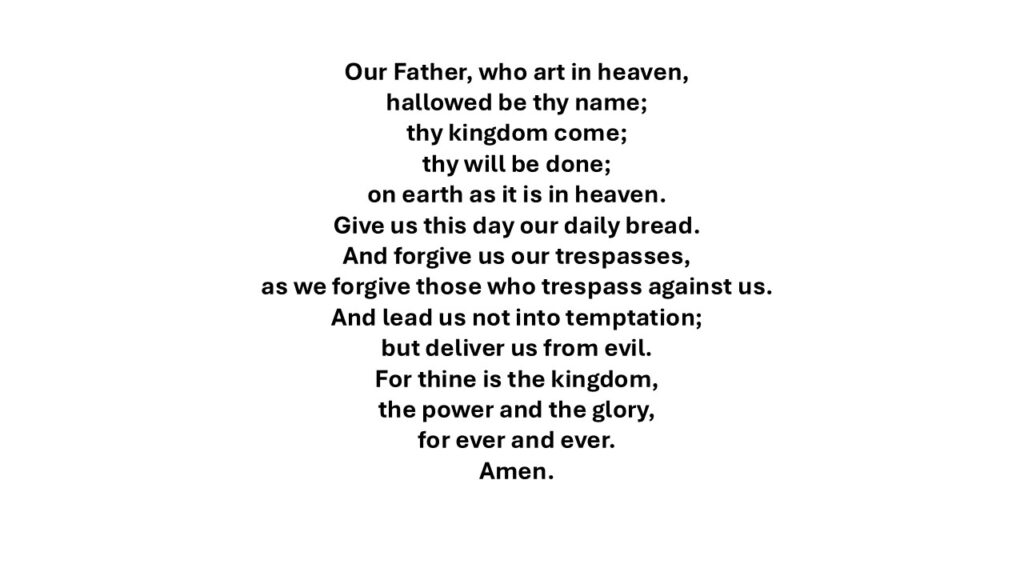
An LCCT blog by Haddon Wilmer. The Lord’s Prayer and how Jesus lived it before he shared it with his disciples

Jesus lived the prayer before he gave it to his disciples, and so to us. Your will not mine be done, Jesus cried in Gethsemane: Your will be done on earth, says the prayer. Give us today our daily bread, says the prayer: Jesus sees the crowd hungry and leads the disciples in giving them bread and fishes to eat.  Forgive us as we forgive: so Jesus prayed, Father forgive the crucifiers who didn’t know what they could have known, for, as Pilate said, This man is innocent.

To pray this prayer, is saying the words enough? Does it not call us to live it, and thus to be shaped by it? Living the prayer takes us on the road of being stirred, reformed and informed by Jesus’ living of it. Are we praying to get things, or is our praying an apprenticeship of living, learning with and from Jesus to be givers, sharing the self-giving generosity of the Father and the Son?   

Some of us say this prayer, rote-learnt from childhood, so often, so easily, that it has no critical bite, so we hear no reiteration of Jesus’ call to deny self and take up our cross to follow him.  

Take very seriously this prayer’s first word – Our. It invites, even commands us, to live the generosity of the Father. I may find myself in a private spiritual place even when a people all around me are saying the words together in church – but the prayer itself, with its clear initial ‘Our…’ speaks against any retreat into ‘solitary Christianity’. There is no ‘I, me, mine’ in this model prayer, rather it is all along, ‘We, us, our’ – because the one God is Father of all.    

We pray, Give us this day’s bread, and, feeling peckish, adjust it to, Give me… So the nagging stomach undermines the ‘us’ and selfishness deafens us to our Father’s call, which is voiced by the seriously hungry  (Isa 58.7)

The name of ‘Our Father’  is to be hallowed, that is, respected and made credible in the eyes of all. When we retreat into the self, religiously, or materially, we contribute to making the world as it largely is, a world where it is hard to believe that we all have one Father, or that his will is really to be done ‘on earth as in heaven’. Faced by this God-unhallowing world, the hopeful wise way forward is to pray, Forgive us our sins, as we forgive those who sin against us. Not forgive my sins and get me to heaven, but bring us into receiving and passing on the Father’s forgiving, responding to its being as wide as the sea, and as powerful as new creation, so that we are given a share in the hard work of forgiving as much as the freedom of finding forgiveness. Enjoy the power and glory of life, living this We-Us project, with and because of Our Father. 

A Christian follows Jesus, wherever he goes. Some thoughts from Haddon Willmer

A Christian follows Jesus, wherever he goes.

Jesus lived in the world of Pilate and Herod, of Pharisees and Zealots, a hectic unsatisfactory political world.  He engaged with it, walked to the city, the polis, of doomed Jerusalem, weeping because it did not know or value what made for its peace.  

Jesus was a political person. But not a competitor for political status or power.

Excited people wanted to make him king, but he withdrew to the mountain (John 6.15). 

He refused outright Satan’s offer to give him ‘all the kingdoms of the world’ if he switched sides (Matt 4.9).

Jesus was political in a human way.  He wielded no sword, presided over no council or court  

He could have chosen to collude with the way society is run by the powerful, but he often found free space for living in the wilderness. 

People hungry for food, health, peace, joy, love went to him there. 

Here Jesus practised politics constructively, not competitively.  As enabling service.

Consider the components of constructive politics: 

He saw the crowds as sheep without a shepherd (Mark 6.34).

He had compassion, and shared his wisdom with them, and healed the sick.

He asked what is to be done for them, now that it was late, and they were far from home and hungry.

He asked the caring question and got an unsatisfactory answer from his disciples – ‘Send them away to the villages  where they can buy for themselves’.

He called disciples to practical generous responsibility – ‘You give them something to eat’.  

Their hands were empty, they could only find a lad with five loaves and two fishes – not enough. 

He led them to risk working bravely with the little they had.   Or put it another way, to risk being surprised by God.

He organized people into tidy fifties, distributed the food and gathered up the left-overs for recycling.

Let us take clues from Jesus and work with him constructively as creative responsible political human beings in God’s world. 

Politics often breeds distrust and disdain, we properly dislike the antics of competitive politics.   But we still have to live together, as we find ourselves, hungry for humanity in the middle of one wilderness or another.   We cannot do without politics of some sort, for we live in the polis, the human community.  We want politics that builds up human community, from the basics, from the rubble we humans often reduce ourselves to. 

Few of us are called to the Westminster village.  But wherever we are,  in family, workplace, community project, political skills, graces and vision are called for.   

For an earlier longer version of this piece, see ‘Does Jesus call us to political discipleship’   https://haddonwillmer.me.uk/does-jesus-call-us-to-political-discipleship/


Haddon Willmer offers us something to think about

Kemi Badenoch read about Fritzl, who imprisoned and abused his daughter Elisabeth for 24 years. Kemi noted that Elisabeth prayed for life from death, but got no timely help, while she herself received positive answers to her ‘trivial’ prayers.   Outcome of this observation?    ‘Like a candle being blown out’- her faith in God went.

https://www.bbc.co.uk/news/articles/c80d7l03137o

How are we to respond to this story? Do not argue about the ‘problem of evil’. Rather, ask what prayer is, what it can be, in any dungeon experience like Elisabeth’s.

Or in Dietrich Bonhoeffer’s. In prison, he said, he was ‘like a bird in a cage, struggling for breath…weary and empty at praying… ready to say farewell to it all’ (poem, Who Am I?).

We need or want things, trivial or vital, and so we ask God to give good gifts to us, his children

(Lk 11,12). Prayer as asking for what we want is honest about our humanity. But prison and things like that mean we cannot have what we want or need. If our candle of faith is not to be snuffed out by the pressures of life more is needed than a supposedly open supply-line. Bonhoeffer gives a clue to this ‘more’ in his letter of 21 July 1944 where he talks of ‘taking the sufferings of God in the world seriously and sharing them in our lives’.

So we pray not to get ‘things’ but rather to be with God in all our life, in the world. God creates, gives, rescues, blesses – all that and more, so pile the words to magnify God, but include ‘suffers’ in the list. God suffers in all his ill-treated creatures, suffers ‘the contradiction of sinners’, God cares, sees things clearly, and so not surprisingly, weeps. If prayer is coming close to God in heart and mind, it takes us into suffering. ‘Christians stand by God in his hour of grieving’

(Poem, Christians and Pagans).

Sharing the sufferings of God means a bumpy drive, instability. God suffers all the negation that human evil and blindness and destructive waste makes. In little and in massive suffering, God suffers. Suffering may drive the thought of God and of prayer from our agenda. If nevertheless, we pray, honestly, with our whole life meeting God in life, we will be drawn and commanded into the way of God’s goodness, and on that way suffering cannot be avoided.

Sometimes the suffering is as devastating as ‘My God why have you forsaken me/us/even yourself?’

There is hope. We are talking not just about the suffering of God, but about the suffering of God. Within the suffering, God is, and God is light in darkness, life against death, love battling Hate, hard pressed but not destroyed.  Christ is Risen and God always is, as he is in Jesus.

Team God… In a most perfect unity – Father, Son and Holy Spirit. By Haddon Willmer

‘Team God’

The doctrine of the Trinity states that God is ‘One in three persons’, but that should not lead us to think there are three gods, or even three parts of God, operating independently from one another, for God is one in a most perfect unity.

Nowhere in the New Testament, the earliest Christian witnesses we have, is there a statement of this doctrine, or the simple formula, ‘three persons One God’. But there are passages in the New Testament where three ‘persons’, the Father God, Jesus Christ, the Holy Spirit, are entwined together in a living way. Then we can see all three are united in the ‘Team God’ playing the real serious game of doing something good with human beings. This team is not like a football team that is trying to beat another team (united against others). It is more like the team in a hospital operating theatre, working together, to bring the patient back to healthy life.

One place where we see this team at work is in Romans 5.1-5. Therefore, since we have been justified by faith, we have peace with God through our Lord Jesus Christ. 2 Through him we have also obtained access by faith into this grace in which we stand, and we rejoice] in hope of the glory of God. 3 Not only that, but we rejoice in our sufferings, knowing that suffering produces endurance, 4 and endurance produces character, and character produces hope, 5 and hope does not put us to shame, because God’s love has been poured into our hearts through the Holy Spirit who has been given to us.

We have peace with God: that is in Paul’s view a great and surprising gift, for he has spent the earlier chapters showing that ‘all have sinned and fall short of the glory of God’ and earning the wages of sin which is death. God created human beings in his image, so that they would display the glory of God as they live in the earth – God called human beings to walk in his ways, and to be a blessing to the world, as they are blessed. But it has not turned out like that. Look at the world, our nation, our selves, we cannot say, complacently, that we image God and reflect his glory.

Peace with God is not to be assumed. Yet God makes peace with enemies, through our Lord Jesus Christ… who died for us.

Why do this great work of peacemaking through Jesus Christ? Why not do it by a simple direct act of divine power and authority? After all, God is free and able to do anything he likes, isn’t he? And God is loving, isn’t he? Why shouldn’t God simply declare ‘I love you: you are accepted’.

One reason why God does not take this quick and easy way is that it would be unrealistic and one-sided. God will not save human beings from their sin without taking their sin seriously. Sin is a great tangle of human failure that has to be untangled, worked through in detail, not cut at a stroke. God wants the string straightened out so that it can be used again for good. The mess of human being has to be repaired from within human being. To do otherwise would be a mere cosmetic job, a superficial con. It would be as shoddy as putting a new coat of smart glossy paint on a rotten piece of wood, to spare ourselves the pain of chisel and saw.

So God becomes human and dwells among us. God in Jesus lives humanly, with all the toil that involved; he suffers under the mess, struggles against it as he finds it in the people he encounters. Jesus lives in faithfulness to God despite all the difficulties, and only so is humanity being remade by God from inside the mess, working through the realities of human living and dying.

In Jesus Christ, we see and are drawn into God’s great costly work of renewing humanity in truth and love. It takes time and trouble, which God is involved in. So through Jesus Christ, we have access to the grace, the good favour of God, in which we stand, and then we can boast, not in our own strength or achievement, but in the hope of sharing the glory, not of ourselves, but of God. And because it is through Jesus Christ, we can’t avoid sufferings, but we can also ‘boast of our sufferings’. Jesus suffered, we know. When God does good to us, through Jesus Christ, God calls us to live our human lives as he lived his, not shrinking from the suffering involved in being faithful to the call of God. And as we walk with Jesus, we cannot exempt ourselves from sharing his suffering in some measure.

And yet, says Paul, we can boast of sufferings – how is that? The short answer Paul gives is that through this life-development of endurance and character- formation, hope arises. Long before we come to the final escape from all suffering, to the place where there is no more crying, no more tears, suffering in the way of Jesus produces endurance, and then character, and out of that hope.

Hope is fragile in this world of hostility, insecurity, futility. We hope and are often disappointed. So we learn to be realistic and not expect too much of life, and that is at least prudent. But if that is all there is, it falls short of what God wills. Along the way of life with Jesus Christ, sharing his suffering, a kind of hope is given that does ‘not disappoint because God’s love has been poured into our hearts through the Holy Spirit who has been given us’. Our human hopes are often fragile. We often hope and end up with disappointment.

Disappointment is an aspect of the suffering in our messed up world. But when we have peace with God, when we live by faith in God and not in ourselves, when we share a common life with Jesus Christ, then the love of God is poured in our hearts. And this is not a matter of our moods, but of the Holy Spirit who is given to us – God the Spirit coming close to our spirits, God finding us in the depths. In the last resort, it is not success that saves us from being disappointed, but it is love. And our weak love needs to be called forth and resourced by God who is love, whose Spirit inspires it generously.

This is how Paul gives us God, Jesus Christ, Holy Spirit, working as a team in an effective operation to rescue human being. God, Father, Son and Spirit, involves human beings in the operation of salvation: it is done with us, not merely to us. It’s the kind of operation that is done without anaesthetic, because it recovers and rebuilds human beings in a genuinely human way – which always has to be with human beings, involving them in the doing as well as the receiving. We don’t have a formulaic Trinity here, but the living God in God’s fullness.

Another way into Trinity: John 16.12-17
I still have many things to say to you, but you cannot bear them now.13 However, when He, the Spirit of truth, has come, He will guide you into all truth; for He will not speak on His own authority, but whatever He hears He will speak; and He will tell you things to come. 14 He will
glorify Me, for He will take of what is Mine and declare it to you. 15 All things that the Father has are Mine. Therefore I said that He will take of Mine and declare it to you. “A little while, and you will not see Me; and again a little while, and you will see Me, because I go to the Father. 17 Then some of His disciples said among themselves, What is this that He says to us, ‘A little while, and you will not see Me; and again a little while, and you will see Me’; and, ‘because I go to the Father’?

All the Gospels show that Jesus lived an ordinary human life, and was known socially as an ordinary member of society, son of the carpenter of Nazareth. And then Jesus surprised them: he healed the sick, calmed the storm, fed the crowds, so that they asked, what sort of man is this? We are faced with someone unusual. Who is he really?

Jesus taught with authority, so they asked: Where did he get all this insight, this practical wisdom, this soaring vision? Jesus responded unconventionally to poor, to marginal and despised people, he proclaimed good news to the poor, and told and showed broken sinners that they were forgiven. And then some asked, Who is this who forgives sins? Only God can forgive sins. Who is this Son of Man who exercises authority on earth to forgive sins? He blasphemes and blasphemers deserve to die.
But others, the poor and blind and penitent who benefited from him, accepted all this as the gift of God, the sign of God’s living presence, for them. God is with him, they said. He is from God. He does God’s work. He is clearly in God’s team. Meeting him, we meet God. When he talks with us, our hearts burn within us. Shall we go to anyone else? He has the word of eternal life and we have come to believe and know that he is the Holy One of God.

In his Gospel, John, more clearly than the other Evangelists, gives us a picture where the difference between God the Father and Jesus becomes paper thin: I and the Father are one, says Jesus. And yet the difference is plain: God the Father is in heaven, Jesus the Son is on earth. No one has ever seen God, human eyes haven’t got the wavelength, but Jesus is visible. God is eternal, immortal; Jesus the Son has his beginning and his end. Jesus talks about his ‘going away’, as his allotted time comes to an end, and he will leave the disciples. Jesus accepted that limit: he had his day, when the light was shining, and so he could do the work given him to do, but he knew the night was coming when work had to stop.

When Jesus died on the cross, he cried It is finished. He had done his work, in his time; he was finished. But it does not mean God was finished. Jesus said to his disciples, I am going to leave you and you are sad – but don’t be inconsolable: I will send you another Comforter, the Spirit of truth: he will take what is mine and declare it to you. You will lose my human presence on earth, you won’t see me any more, but I will come to you in the Spirit.

So we have another picture of the Trinity team in operation. All that the Father has, has been given to the Son, and the Spirit will take all that belongs to Jesus the Son, all that comes from the Father, and will share it with you. It won’t be shared with disciples for their exclusive benefit, to make them individually a more happy, or balanced, or successful persons. God does nothing to help us in the competitions of life, the quest to be great or the greatest, in this or that way.

Jesus said, If my life went on forever as my own personal life, so that my beautiful being was preserved in its health and prosperity and its gladness about itself, it would be godless, alone and useless. It would be futile, like a seed that was never put in the soil. But Jesus said, a seed should be put in the soil, hidden away in the dark dampness, so that it will die: for if it dies it bears much fruit.

That takes us to the heart of the unbearable reality of God as we see God in Jesus Christ: the God who loves and gives Godself for the life of the world. And when the Holy Spirit shares all that God has, all that God is in Godself, we are not offered blessings and powers which enhance our individuality. We are called insistently, every day, into the way of Jesus, the seed full of the life of God, that falls into the ground and dies.

That was the way Jesus went. The Son who was one with the Father lived his humanity right into the separation of death, and out of that has come much fruit. The Spirit which is free as the wind, that is free to go anywhere, comes to places and to times that Jesus could not reach. All through the world, long after the day of Jesus on earth ended, the Spirit shares the life of Father and Son with human beings.

Jesus brought us God in a living human person, intensely local, in a limited moment. The power of life was packed into that littleness, like a seed. The Spirit is God bursting out like the blossom and fruit that comes from a seed that dies. So much from one little seed: the Spirit in the world from the Son and the Father.

This is the story of God in action, a team of three, each playing its part, together making a more perfect unity than we can get our minds around. It is the story still being made by God, involving human beings all the way.

Recognizing and talking about sin

Talking about sin is difficult, so we avoid it.  It threatens our mental health and self-esteem.  But sin meets us massively in the world: we cannot deal wisely if we do not recognize it.  Political discourse becomes deceitful, evasive, and merely euphemistic when there is no political will or words to confess sin. 

Some take refuge in the belief that climate change was caused by the sun, so the earth and its inhabitants are innocent victims. Now we know the rise towards 1.5 degrees and beyond is significantly down to human activity. Individuals may deny responsibility, claiming they are swept along helplessly in the tide of impersonal forces, like population growth generating consumption beyond earth’s capability. But sin is more than guilt that can be pinned without remainder on offenders; it is sin when the ‘innocent’ individual refuses to accept that they are members of the community, who have their being only in sharing with others. Goodness, as opposed to sin, makes itself responsible for the plight of the world, even when it has done nothing to cause that plight. So God in Christ bears the sin of the world, being ‘made sin’ (II Corinthians 5.16-6.10) and only from that truthful point bringing new life to birth. 

We cannot now save ourselves from climate disaster unless we think and act communally and give ourselves to the common whole-world enterprise without claiming exemptions.  

The West is abandoning Afghanistan shamelessly, as though we are innocent and Afghans must take responsibility for the disaster. We say we can be proud of enabling the education of girls and are still unfazed by our overall failure.  We have spent many billions on fighting a war to keep al-Qaeda from our streets, but as this piece in the Guardian points out we have put too little money into Afghanistan’s governance and development. https://www.theguardian.com/commentisfree/2021/aug/13/whatever-happens-next-in-afghanistan-a-humanitarian-disaster-is-already-in-train  

We have the expertise to fight for our own interest, till we are weary, but not so much wisdom or humility to help other people to live better.  Yet still we are not ashamed: those whose prime concern is their own safety will not be ashamed when they fail those they count as less valuable.  So our sin is unveiled in this history, but we refuse to know what we are doing – and that refusal is deep sin. 

Haddon Willmer    

Jonah 4 and I Corinthians 13

[Jonah Awaits the Destruction of Nineveh – copyright Trenét Worlds]

What do we get from Jonah?

If I preach to the Ninevites so they turn from their sin
If I pray from the depths in the most spiritual language
If I give my body to be thrown into the depths to save drowning sailors
And have not love – I am nothing

I am nothing because I am far from God
I do not know him in his works or his spirit
I do not share his mission
I preach his word powerfully to others but I do not hear it for myself
I resist God’s arguments with me to the end
It is not clear what will become of me, but so far as the story goes,
I am nothing

I am angry where God is patient
I want destruction while God wants reconstruction
I see they need to be converted but I do not want them to be converted
I see they need to be converted but I cannot see that I need to be converted
I see and make enemies while God values and is faithful to all his creatures
I think I am special and am not content to be like other of God’s creatures
I am privileged because God keeps on talking to me
But I am nothing because I do not get what keeps God going

I care about my comfort under the gourd;
The value it has for me is measured by my loss when it withers in the sun
But still it is a puzzle to me why God should value the children
And all the cows in Nineveh:
I have no sympathy for God when he contemplates losing his creatures.

I think out of my anger and disdain and go away from God
I pray but what do my prayers mean?
I am godly, unlike the Ninevites, and all the others I look down upon,
But in my godliness, I am godless and I don’t know it
Indeed I think in my pride my way is better than God’s

I am without God because I am without love
If I have not love, I am nothing

For God is love

Haddon Willmer

A film to see, a song to sing

The film, Lilies of the Field (1963) is fascinating, beautiful, simple. It could be argued it is like the Sermon on the Mount, too good and too hopeful to be true. Or maybe it has the truth of whatever is good, for the really good always verges on the too good to be true. The people in the story are not goody-goody cut-outs. Some are proud, some selfishly calculating, some naïve, some sceptical, some awkward, but their faults are subsumed into an abounding grace which comes upon them all. The grace is what makes the whole story, in a strange, unexpected way; grace comes to light in the making of the story. People make their various limited contributions to the happening, with varying degrees of willingness; some work and suffer considerably to make it happen; but at the end of the story, when the work is done and stands there as an abiding and worthy achievement, none of them can claim credit for it.

I have told you the story without telling you anything, so I have not spoilt your entertainment. It really is a good film to watch – for all ages.

I had never heard Jester Hairston’s song, Amen, which we hear twice in the film. You can see Hairston singing it here on YouTube.

It is a great telling of the story of Jesus.
Hairston was a remarkable man – see this link on Wikipedia

God troubles Job

Why do the innocent suffer?  That is one question running through the book of Job.  Job was a good and prosperous man, who lost his family, property and health in sudden disasters.   Some tried to argue that the good do not suffer, so there must have been something wrong with Job to cause his troubles.  Job does not accept that and complains about a world that is unjust, where the wicked prosper, get bonus after bonus, and are never called to account.  His advisers argue there is justice in the long run – for example, if the wicked man gets away with it, his sons will cop it.  Job is not satisfied with that answer.

Job 21.19  ‘You say, God stores up their iniquity for their sons.  Let him recompense it to themselves that they may know it.’   Job wants the wicked to suffer appropriately, and to have to pay up, so that they have to acknowledge and feel the wrong they have done.

Job has a strong sense of the individual before God.   So he looks for God’s wrath to be directed in justice to the precise places where it is deserved.

But that is not the heart and source of his view.  His prime concern is not that the wicked should be punished.  He is wrestling with his own situation.

He knows he is innocent or better, righteous.  He will maintain that.

But he knows that in his trouble, it is God he is facing.   He cannot stand outside his trouble, so that he is free to ask, ‘Why should God allow this, or do this to me?’   He does not say, ‘I have troubles, God is responsible, how can God justify himself?’

He rather says,  ‘My bodily troubles are bad and depressing in the extreme, but they are not my real problem.   It is rather that troubled as I am, I am before God.  God comes to me in my troubles, so he is the troubler.  In my troubles, I get no peace, no comfort.  They are the form of God to me: he does not let me alone.  Troubled as I am, I cannot say, ‘This is merely an accidental, earthly, animal occurrence, it has no personal or spiritual meaning, so my spirit can serenely rise above the suffering to be with God.’

‘No, God is after me’, says Job, ‘he will not leave me alone’.   ‘In God’s hand is the life of every living thing and the breath of all mankind’  12.10.   This general truth is emphasised and illustrated extensively in the book of Job.  Job’s trouble is a  particular occurrence of this general truth, the way it works out for him.   There is no escape from God.   You think that is comforting news?  For Joh, it seemed to mean trouble with little hope of light and peace.  Job sometimes says he wants to speak with the Almighty and argue his case with him (13.3) but at other times, Job thinks the only hope is for God to leave him alone, so that he can find a few days of brightening up, before he goes ‘whence he will not return, to the land of gloom and deep darkness’ 10 20-22.    (This is one reason why even many religious people give up on God: they sense that God might come for us, as he came for Job.   We would like to make our case to God, to speak frankly with God and call God to account, but we do not have the freedom to do that.  Before we can speak with God, God must take the pressure off.  So Job sets out the conditions under which he will talk with God: ‘Withdraw your hand from me and let not dread of thee terrify me.  Then call and I will answer…’ 13.20-22.  But sometimes, God does not leave some people alone, to get on with their life without his hand on them in a troubling way.  7.11-21: why does God make so much of human being, visiting him every morning?   ‘Will you never take your eyes off me long enough for me to swallow my spittle?’)

It is on this basis that Job appeals to his friends, who torment him with their words  19.1  They should not do this.  They should understand that even if he has done wrong, his error remains with himself – 19.4.   They should leave him alone with his responsibility and not interfere, as though they can make themselves great by humiliating him  19.5.

This is a form of the argument of Romans 12.19-20, Lev.19.17-18: Leave vengeance to God and do not interfere or try to do God’s work for him Romans 14.4.   A major issue here is knowing how to practise this wisely: for there has to be some sort of judging enacted in society by human beings.   We tend now in our secular society to ignore God altogether, and so to make social, ie state judgment final and complete.  But it is still the same as it always has been:  the human enactment of justice is often incomplete and cannot be counted as final; it leaves the victim unsatisfied, so that they have to find some other help in moving on with their lives; it is often clumsy and mistaken, and does not do redemptive justice to the wrongdoer; and when it escalates its own cruelty in order to match the heinousness of the crime it strays from the service to humanity which is the basis of its authority.

So we need human judging, but it needs to act with humility within limits.  That is what Job asks his friends  to exercise: not to magnify themselves by being haughty assured critics who humiliate him.   Job does not pursue this argument by pointing out the limits of human justice (as I have done in the last paragraph) and asking his friends to limit themselves.  Human beings, especially once they are on their high horse, are not very good at limiting themselves.  Rather Job calls God into the argument.

He does not call God into the argument to defend him against his critics (God at the end of the book 42.7 appears like that) but rather Job asks them to limit their own critical humiliating endeavours  by taking note of God in the situation.  ‘Know then that God has put me in the wrong and closed his net about me’  19.6.   They can see Job is in trouble, and so they speak down to him, diagnosing his trouble and advising him – and all the time, they have not noticed or taken the measure of the most significant thing about Job’s trouble: God is there, not indeed as his helper or comfort but as the one who has ‘put him in the wrong’.

We should not think ourselves superior to Job’s friends for most of the time, we are not very good at noticing when God is there putting people in trouble.  Indeed good kind Christians today are as bad as other good people at not being able to imagine or feel that when people are in trouble,  they have been targeted by God and that the trouble is not to be understood except as the manner and the place of God’s coming close.   It is a terrible thing to think;  it is a dangerous way to think about people’s troubles.  Indeed part of the lesson of Job is that we should hesitate to interpret anyone else’s troubles in these terms.  But the other part of the lesson of Job is that as a human being I,  for myself, may, in the course of life, be led into troubles, and that as I live through the trouble, I discover that at its heart or alongside it, God is putting me in the wrong.   Then God becomes my real trouble.

Because Job’s friends could not interpret Job’s troubles in this way without putting themselves in the wrong, it is right that pastoral practice and spiritual direction in church does not work in these terms.   Our pastoral practice assures people that God is with them and for them;  it does not talk of God putting you in the wrong.   But it is one of the limits of the best pastoral practice that there are things it cannot and dare not say.   Job’s friends simply have to keep quiet.  Yet Job in trouble cannot be comforted with the one-sided cheerful pastoring.  Job has been picked out by God and there are dark places he must walk through, because God has  ‘walled up his way’  19.8.   The church that may not pastor in these terms can, at least, read Job, which most churches never do these days.   Without pointing the finger or interfering with other people’s relation with God, reading Job would cause us to be sensitive to strange but pressing dimensions of human living with God.   It would mean that as a community we did not build and promote a culture which blocks out the discoveries the righteous man Job made when God put him in the wrong.   Reading Job might help us to know better what we are given in Jesus Christ, who in his dying, cried out, My God, My God, why have you forsaken me?

Jesus took those words from Psalm 22, a very Job-like Psalm.  What it is to be abandoned, Job describes in 19.13-20.  His family and friends have turned against him – even young children despise him.  All that is the form and measure of his trouble.  Job asks his advisers who magnify themselves and humiliate him to notice his abandonment.   He asks them not to analyse his problem and tell him how to behave, but simply to ‘have pity on me, o you my friends’ 19.21.    Why should they have pity on him?  Because they want to be better than all his other friends, who have left him?  Because they remember they too are sensitive human beings and they would not like this to happen to them – Do as you would be done by?   These good reasons for decent behaviour are not what Job points them to. They should have pity on him, ‘because the hand of God has touched me.’

He brings them back to the key point:  Job’s trouble is with God.  It does not follow that his friends must help him to put right his relation with God.  Job’s relation with God has gone into territory where they have evidently never been.  And in any case, if God is touching Job it is not for them to interfere.   So Job asks. ‘Why do you, like God, pursue me?’  19.22.   Do you think God needs some assistance?   Do you want to get on winning side?’     No:  if you see the hand of God touching someone, know that it is not your business to pursue them.  You will add to their troubles, but you will not be doing the work of God.   Have pity.  Stay with them in silence.  Maybe you will get close to Job in his trouble and find yourself in trouble with God.

Reading the riots: a NEET question comes home

Rowan Williams, the Archbishop of Canterbury, writes in The Guardian  today:

The big question Reading the Riots leaves us with is whether, in our current fretful state, with unavoidable austerity ahead, we have the energy to invest what’s needed in family and neighbourhood and school to rescue those who think they have nothing to lose. We have to persuade them, simply, that we as government and civil society alike will put some intelligence and skill into giving them the stake they do not have. Without this, we shall face more outbreaks of futile anarchy, in which we shall all, young and old, be the losers. 

http://www.guardian.co.uk/uk/2011/dec/05/riots-return-young-archbishop-canterbury

http://www.guardian.co.uk/commentisfree/2011/dec/05/reading-riots-nothing-to-lose

We are also reminded that

In the aftermath of the August riots, the prime minister, David Cameron, was quick to dismiss the idea that poverty was a factor in the disorder. “These riots were not about poverty,” he said. “That insults the millions of people who, whatever the hardship, would never dream of making others suffer like this.”

This is a mistaken interpretation.  It is true that many people who are poor did not riot; many of them would not riot and loot even if the opportunity came near to them.  But that does not mean that poverty did not have a major effect on some people, leading them to riot or steal, at least opportunistically.  

This is where we need more sensitive analyses and descriptions, such as those coming out of the Reading the Riots study (http://www.guardian.co.uk/uk/series/reading-the-riots) which the Archbishop comments on. 

Different people react to any particular situation in different ways.  

We need to understand why some people respond to difficult circumstances in unhelpful or bad ways, and then out of that understanding, we can see how to help them and how to change the circumstances for the future.  That is the argument and the spirit of the Archbishop’s article. 

The big question….for us, the church

‘The big question Reading the Riots leaves us with is whether, in our current fretful state, with unavoidable austerity ahead, we have the energy to invest what’s needed in family and neighbourhood and school to rescue those who think they have nothing to lose.’  

Church is not mentioned  by name, but it belongs here.   The church is a local centre of some visible social energy: people come together to make a sort of community.  And the church claims that the heart of its own heart is the energy of God in Christ by the Spirit.   

So the big question comes home to us, the church: have we ‘the energy to invest what’s needed…to rescue those who think they have nothing to lose’? 

Who have nothing to lose?

When we talk about ‘those who think they have nothing to lose’ we are talking about many more than those who rioted or might riot.  There are

‘people who have vague but strong longings for something like secure employment, and no idea where to look for it; who on the whole want to belong, and live in a climate where they are taken seriously as workers, as citizens – and as needy individuals; and who have got used to being pushed to the margins and told that they are dispensable’.

How many have ‘lives in which anger and depression are almost the default setting, thanks to a range of frustrations and humiliations’?  

There are many, ‘in our current fretful state, with unavoidable austerity ahead’.  

There are, for example,  a record number of NEETs –  16- to 24-year-olds not in education, work or training in England.    There are now  nearly 1.2 million, 15.6% of this age group.   http://www.guardian.co.uk/news/datablog/2011/feb/24/neets-statistics#data

Do you know what it is like to be a NEET, not by choice, but out of disadvantage, finding no door to life open, applying for jobs and never getting one, having the dreams of childhood stripped of all chance of realisation?   Have you ever got close enough to a NEET to begin to see. 

What happens to a NEET who is older than 24?  They have got used to a life where they count for very little, and now they cease to be counted in this statistic.  They join many other young people, who may have a job of some sort, but see no chance of ever getting their own home, what with the shortage of housing and the cost of mortgages.   They are not all disadvantaged from early years – many have degrees – but,  in their early adulthood, they are together as those who look towards the future and see more than austerity ahead.  It is more like sterility, existing but not living.   

Here is a big question that comes home to us as church.   Do we hear it?   Do we have the love and respect to hear it?  Do we have the energy to invest?   It is a searching question which may find us out uncomfortably.

Life options in Gethsemane

When they came to arrest Jesus in the Garden of Gethsemane, one of the disciples drew his sword and struck the slave of the high priest and cut off his ear.
Then Jesus said to him:
“Put your sword back into its place; for all who take the sword shall perish by the sword.
“Do you not think that I cannot appeal to my Father, and he will at once send me more than twelve legions of angels?
“But how then should the Scriptures be fulfilled, that it must be so?”
 

Matthew 27. 52-54

Jesus the way-finder

All through the Gospel story, we can see Jesus finding his distinctive way, discerning and doing his Father’s will.    

It is not an obvious path.  Jesus calls us to go a narrow way, which is hard to find (Matt 7.14).  He could call us to find it, even though it was not easy, because he was already living in that way,  always looking for it, always learning, always daring it. So it was in the desert when he was tempted  (Matt.4.1-11).  He considered the options which might fit the task he had been given in life: to live as the beloved Son of the Father, proclaiming the coming of the kingdom of God, fulfilling all righteousness from one situation to another in a fast-moving history (Matt.3.13-17). He turned down Satan’s obvious common-sense ways to achieve his goals for God.  He found other ways, unlikely ways, hard ways.    

All through his life he was choosing narrow ways, and inviting others to go with him. 

At the end, in the Garden of Gethsemane,  it is still the same.

Option One: the Sword

One obvious commonsense response to the gang who came to arrest him was the Sword.  

So one of his disciples thought: Kill your enemy – if you miss his head, you may still get his ear.  At least, you will have done something.    

This is the way we all follow most of the time. In some countries many people have their own guns, for self-protection. In this country, we shun personal firearms, but we live within a public order guarded on occasion by armed officers. We find it hard to imagine how we could cope without the sanction of force as the final resort.  

Jesus said: All who take the sword shall perish by the sword.   Does this mean all use the sword will, sooner or later, be killed by the sword?  Using the sword does not have to lead to unlimited killing, though there is always a danger that it will.  The truth in this word of Jesus, and the wisdom of it, does not depend on whether the sword gets turned back on every user or that every bomber is hoist with his own petard. As Jesus saw it, walking on the narrow way, to use the sword implies  relying on it to solve problems. Those who trust in the sword find that it defines the possibilities open to them, shaping their values and vision. Those who take the sword find themselves limited by it. 

We know what this limitation is in practice as we reflect on our engagement in Afghanistan.   We engaged there because some good needed  to be done, so we thought. We had military power so we put it to work.  And then, somewhere along the road, it dawns on us that there is no military solution to the tangle we have got ourselves into – we must be working for a political way forward.  We have to use soft power. It is a matter of hearts and minds, and they cannot be shaped by the sword. 

And now we seem to have the same problem in Libya.  Everyone, and certainly the British government, is in danger of being limited by its vision of the problem, expecting the civil war to be won militarily by the right side (the rebels, not Gaddafi, who, we say,  must go, because there is no place for him in the future).  But it may be a long time before the disorganised rebels get near to winning, and along the way, wounds will be opened that may bleed for a long time.   We need more than the sword in our  imaginary and practical armoury. 

Gethsemane is a great clarifying moment in the mission of Jesus, and very instructive for all of us who want to be his disciples. So Jesus in this mortal crisis enlightens us with his wisdom, which comes from his own living.  Lethal force tempts us to think we have the decisive solution to problems in our hands – but it does not work as we would like it to.  It is wise then to consider other options. 

Option Two:  Angels

If the sword is put back in its place, what other way is there – in tight corners like Gethsemane?

Ask the Father:  pray for twelve legions of angels.  That will see off the high priest’s minions – it would dispose of the Roman army too.  This is divine power in miracle, in answer to prayer. And Jesus says No to this option too.  

Good believer, does that not seem strange and upsetting to you?   Are we not called to pray with faith, and so to move mountains?  

We accept Jesus’ saying No to the sword, but can we go with him when he says No to heavenly miracle?    This is a blow to lively, adventurous Christianity. It is a discouragement to faith. But if we are determined to solve life’s problems by having the twelve legions of angels riding to take us out of Gethsemane,  we will not be going forward with Jesus. If we must not take the sword, lest our whole being gets imprisoned in reliance on deadly force, we should be careful about praying in ways that value God because his deadly force is much more than ours could ever be.  Both ways, the victory is handed to deadly force, not the life of love, and the love of life. 

Option three:  being fully human in God’s way

But what third way can there be?  

The sword is practical, even if destructive.  Trusting God for miracle is conceivable.  But a third way – can we see it?   The gate to it is not only narrow but disguised.

It is indeed disguised in God’s becoming human.  

Jesus in the desert refused any power Satan could give him to achieve his mission.  So now, he declines to ask the Father for the miracle of twelve legions.  He holds on to what he has been given in life, what he has discovered in learning: it is necessary for the Scripture to be fulfilled and his life takes its shape in serving that fulfilling. Jesus was dedicated to doing God’s will in God’s way.   

Does this mean that God had a detailed plan, which had to be followed to the letter?

And did Jesus know this plan, because he could read the cryptic clues which were scattered through the Scriptures? Did Jesus live by the book in this way?  Is that the view of Jesus you get from reading the Gospels? If the Bible has cryptic clues laid down long before the event, and then Jesus lives a life which fits into them, that looks like a miracle.  Quite a few people think of it like that. They read the Bible to decipher the clues and they believe in Jesus because what happened to him fits what was apparently foretold.  

If this is how it is, we do not have a third option here – we have a variant on the miracle of the legions of angels. (Note that Jesus does not deny miracle – he just says it is not the way for him or for us in the present world, in Gethsemane. By declining to go this way, he must look for a third option, and commits us to doing the same.)

The third option is not to get a miracle, to take one out of the tight corner or to give fatalistic assurance of being right. The third option is so narrow and hard it makes Gethsemane unbearable.  Jesus prayed with blood and tears to see it and to get going on it. This option is to go on and go through with the human life given to him, in the place and time where it is given.

Living human life, loving God with all our heart and soul and mind and strength, and our neighbour as ourselves, is what we are called to in the Scriptures. All the commands of God, given us in Scripture, are summed up in this commandment to love.  It commits us to living from the beginning to the end of life in a particular spirit.  The Scripture tells us that God gives us life in human form and it is in living human lives  that we glorify and thank God, offering to God as a living sacrifice  the whole being that we have in and with our bodies (Romans 12.1,2).   Often, in this life in the body, this life on earth, great, joyful and surprising gifts are given us, and we find the language of miracle is just what we need to describe what we have met on the way.   Often too, life is narrow and threatens to close down altogether:  then,  Jesus says,  we will go on with God and not be tempted by either sword or miracle.   And Jesus does all he can to guard us from doing anything else: Put up your sword, he says – and heals the poor servant’s ear.  And lets himself be taken.  

Jesus is God’s way of being fully human, from beginning to end.  The good news is that Jesus shares and opens up God’s way of being human, so that we too may become fully human. Jesus opens, and keeps open, that way of being human even when we are in Gethsemane, when we are invited to be watching with him, but can only ‘sleep for sorrow’ (Luke 22.45).  

Jesus keeps open the way by being himself, to the end.  He is the Way – our way is with him and in him.   He is here for us still, the One who kept to God’s way of being human, even in Gethsemane and Golgotha, is the Same who is eternally our Brother, Guide and Path. 

Jesus keeps open the way for us, in the crisis of pain, fear and loss, by refusing the sword and  by declining miracles, for both tend to exempt us from being faithful to our calling and his, to live in God’s humanity.

PHP Code Snippets Powered By : XYZScripts.com